
Access Humboldt County Divorce Records
Humboldt County divorce decree records are maintained by the Superior Court in Eureka. The courthouse at 421 I Street handles all family law cases for the county. If you need a copy of your divorce decree, you can request it from the court. The phone number is (707) 445-7256. The court provides certified and plain copies of divorce records. You can get records by visiting the courthouse or by sending a written request. Certified copies of dissolution judgments typically cost $15. Regular copies are 50 cents per page. The court has a case record request form available on their website. This form helps ensure you provide all needed information when requesting documents.
Humboldt County Quick Facts
Courthouse Location
The Humboldt County Superior Court is at 421 I Street in Eureka, California 95501. Eureka is the county seat. All divorce cases in Humboldt County are filed at this courthouse. The main phone number is (707) 445-7256.
Court hours are generally Monday through Friday from 8:00 AM to 4:00 PM. Hours may vary on holidays or for special court closures. It is smart to call ahead before visiting to confirm the court is open and the clerk's office is available.
Humboldt County is located on the northern coast of California. The courthouse in Eureka serves all county residents. This is the main location for all court records including divorce decrees and family law documents.
When you visit the courthouse, go to the clerk's office. Tell them you need a copy of a divorce decree. Bring photo identification with you. The clerk will need information about your case to locate the file in the court system.
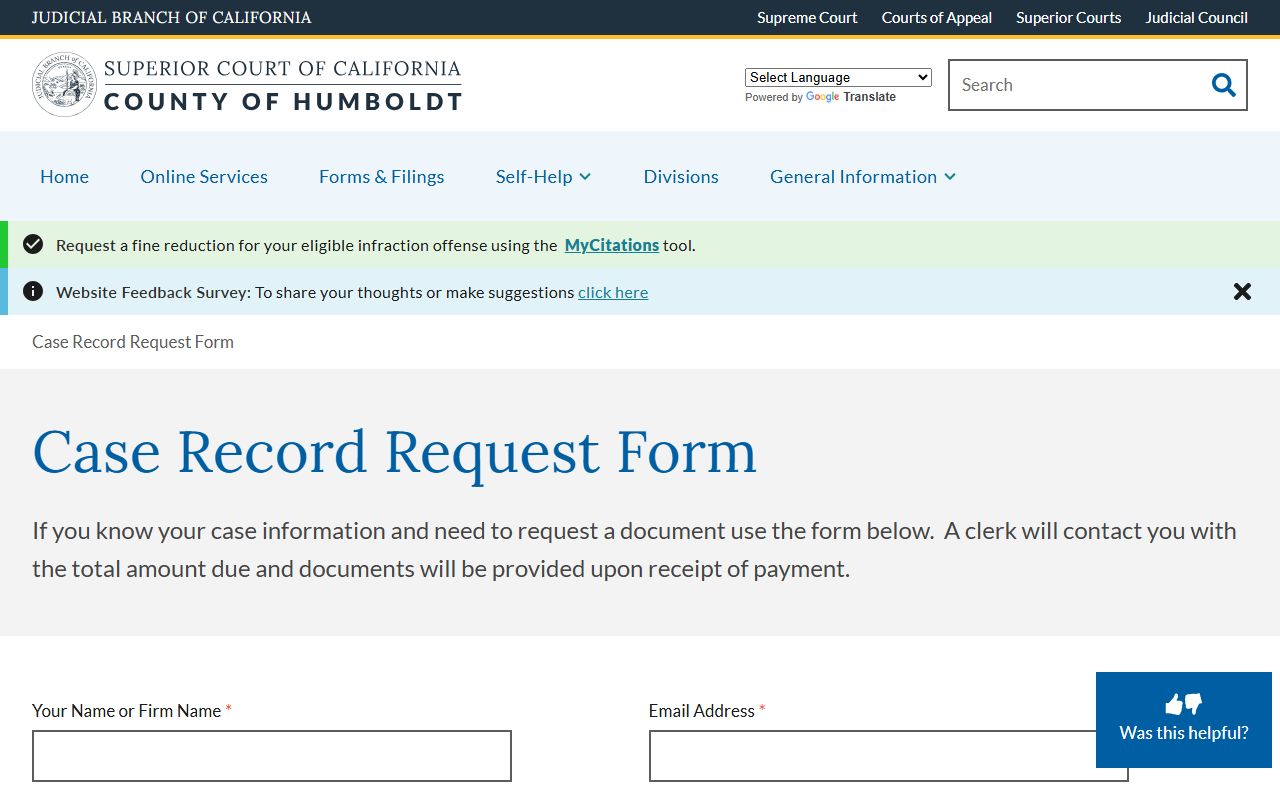
Case Record Request Form
Humboldt County Superior Court has a case record request form available. According to humboldt.courts.ca.gov, you can use this form to request copies of court documents. The form helps you provide all the information the court needs to process your request.
Using the official form is recommended. It ensures you include all required details. The form asks for party names, case number, date of filing or divorce, and which documents you need. It also has space to indicate if you want certified or plain copies.
You can download the form from the court's website, fill it out, and submit it in person or by mail. Include payment with your completed form. The court will process your request and provide the copies you need.
If you do not use the form, you can still submit a written request. Just make sure to include all the same information that the form asks for. The more details you provide, the faster the court can locate your case and fulfill your request.
Getting Your Divorce Decree
To get a copy of your divorce decree, you need to request it from the court. You can do this in person or by mail. In-person visits usually result in faster service. The clerk can search for your case while you wait and tell you what documents are available.
Provide as much information as you can. This includes the full names of both parties, the date the divorce was finalized or filed, and the case number if you know it. The case number makes it much easier for the court to locate your file.
If you go in person, bring a valid photo ID. The court may require identification to release records, especially if you are requesting your own divorce documents. Once the file is located, you can specify which documents you want copied.
For mail requests, write to Humboldt County Superior Court at 421 I Street, Eureka, CA 95501. Address it to the Clerk's Office. Include all case details, your contact information, payment, and a self-addressed stamped envelope. Processing time for mail requests varies based on the court's workload.
Fees and Costs
Humboldt County follows the California statewide fee schedule. Certified copies of dissolution judgments cost $15. This fee is set by California Government Code Section 70674. The certification fee covers the official court seal that validates the document.
Plain copies without certification are 50 cents per page. If your divorce decree has multiple pages, you pay 50 cents for each page. Other court documents that need certification, such as orders or agreements, cost $40 per document plus the per-page copy fee.
If the court must search for your case and the search takes longer than 10 minutes, a $15 search fee may be charged. You can avoid this fee by providing the case number when you make your request. Search fees are in addition to copy and certification fees.
Payment should be made by check or money order payable to Humboldt County Superior Court. Some locations may accept credit or debit cards for in-person payments. Ask the clerk's office about accepted payment methods before submitting your request.
Note: Fees can change, so always confirm current costs before sending payment.
Understanding Your Divorce Decree
A divorce decree is the final court order that officially ends a marriage. In California, it is called a Judgment of Dissolution of Marriage. The decree states that the marriage is dissolved and provides the effective date when the divorce becomes final.
The decree may also contain terms about property division, spousal support, child custody, and child support. Some divorce decrees are brief if the parties agreed on all issues. Others are lengthy with detailed provisions about finances and children.
You need a certified copy for most official purposes. Government agencies, banks, and other institutions typically require the court seal. A certified copy has legal weight. A plain copy is fine for personal records but may not be accepted for official transactions like name changes or updating Social Security records.
The divorce case file contains more than just the final decree. It may include the petition, response, settlement agreements, financial disclosures, and other documents. You can request any public documents from the file. Some may be confidential or sealed.
Privacy and Public Access
California law protects certain information in divorce cases. Under the California Rules of Court, Rule 2.503, courts may not provide remote electronic access to family law case files. This means you cannot view actual divorce documents online from home.
Courts may provide limited information online such as case numbers, party names, and hearing dates. But the full case documents are only available at the courthouse or by ordering copies through the clerk's office. This protects privacy in sensitive family law matters.
Some documents in divorce files are confidential. Financial disclosures and declarations about children may be sealed or restricted. The court clerk will inform you if any documents in the case you are requesting have limited access.
If you were a party to the divorce, you have full access to your own records. If you are not a party, you may still be able to get copies of public documents, but confidential information may be redacted or withheld.
California Divorce Laws
All California divorces must follow state law. California requires a six-month waiting period before a divorce becomes final. This is set by California Family Code Section 2339. The six months begin when the respondent is served with divorce papers or appears in court, whichever comes first.
The divorce decree must specify the date it becomes final. This requirement is in California Family Code Section 2340. This date is important for legal matters like remarriage or updating official records.
The court clerk has a duty to maintain divorce judgments in the court records. The clerk must also notify both parties when a judgment is entered. These duties are outlined in California Family Code Section 2338. This ensures proper record keeping and that both parties receive official notice.
State Records vs Court Records
The California Department of Public Health keeps limited divorce information. According to cdph.ca.gov, they only have records for divorces filed between 1962 and June 1984. They do not have actual divorce decrees.
What the state provides is a Certificate of Record. This shows basic information such as names, filing date, county, and case number. It does not show if the divorce was finalized or include any terms of the divorce. It is not the same as a divorce decree.
For the actual divorce decree, you must contact the Superior Court in the county where the divorce took place. For Humboldt County divorces, that means contacting the courthouse in Eureka. The court has the complete file including the final judgment.
Processing time for state vital records can exceed six months. It is much faster to get records directly from the county court.
Legal Help and Resources
If you need help with divorce records or family law matters, several resources are available. The California Courts website at selfhelp.courts.ca.gov has information about getting copies of court records. This is a free state resource with forms and instructions.
Legal aid organizations may provide free services if you meet income requirements. Legal Services of Northern California serves Humboldt County. They assist with family law cases for eligible clients. Contact them to see if you qualify for help.
The State Bar of California offers a lawyer referral service. You can find a family law attorney in Humboldt County through their website or by phone. Private attorneys can provide legal advice and representation for a fee.
The Humboldt County Superior Court may have self-help information available. Ask the clerk's office what resources they offer to help people navigate the court system.
Nearby Counties
Humboldt County is on the northern California coast. It borders several counties, each with its own Superior Court system.