
Find Del Norte County Divorce Decree
Del Norte County divorce decree records are kept at the Superior Court in Crescent City. The court handles all family law cases for the county. If you need a copy of your divorce decree, you can get it from the courthouse. The court maintains files for all divorce cases filed in Del Norte County. You can request records in person at the courthouse or by mail. Certified copies of divorce judgments cost $15. Plain copies are 50 cents per page. The courthouse is located at 450 H Street, Room 209, in Crescent City. Court staff can help you find your case and get the documents you need.
Del Norte County Quick Facts
Court Location and Contact
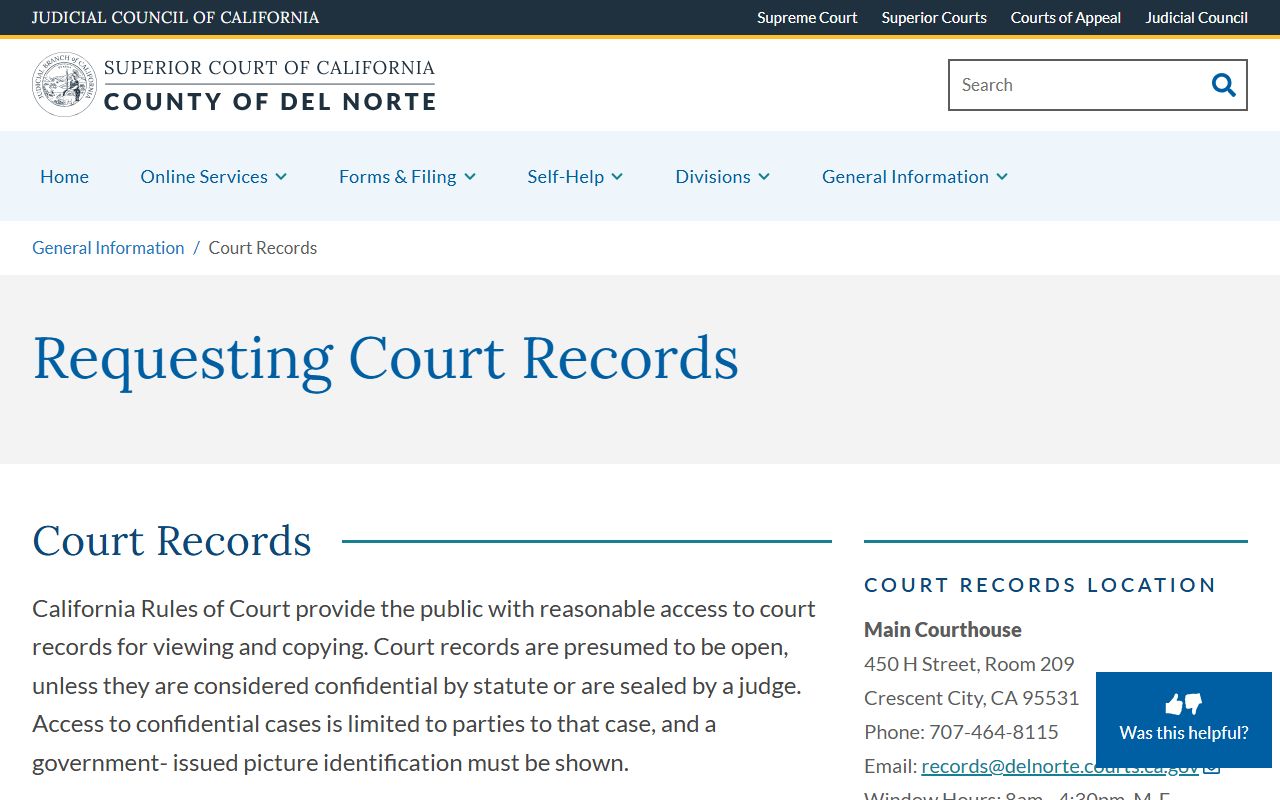
The Superior Court of California, County of Del Norte, is at 450 H Street, Room 209, Crescent City, CA 95531. This is the only courthouse in Del Norte County. All divorce cases are filed and maintained here. The phone number is (707) 464-8115.
Court hours are typically Monday through Friday from 8:00 AM to 4:00 PM. It is a good idea to call ahead to confirm hours before you visit. The clerk's office can answer questions about how to get copies of court records. Staff can tell you if your case file is available and what documents you can request.
Del Norte County is a small county in the far northwest corner of California. The courthouse serves all residents of the county. Crescent City is the county seat. Most court services are provided at this one location.
According to delnorte.courts.ca.gov, the court maintains records for all case types including family law. You can access information about court records and request procedures on their website. The court follows California state law for fees and access to divorce records.
Getting Copies of Divorce Records
You can request copies of divorce decree records in person or by mail. If you go to the courthouse in person, bring photo identification. Tell the clerk the names of both parties and the approximate date of the divorce. If you know the case number, that will speed up the process.
The court will search for your case. If the search takes more than 10 minutes, there may be a $15 search fee. Once the case is located, you can request copies of the divorce judgment or other documents from the file. Standard copy fees apply.
For mail requests, send a written request to the court at the address above. Include the full names of both parties, the date of divorce if known, and the case number if you have it. State which documents you need. Enclose payment and a self-addressed stamped envelope. The court will process your request and mail the copies to you.
Processing time varies based on court workload. In-person requests are usually handled the same day or within a few days. Mail requests may take several weeks. If you need documents urgently, an in-person visit is best.
Fees and Payment
Del Norte County follows the California statewide fee schedule. Certified copies of divorce decrees cost $15 under California Government Code Section 70674. This is the standard fee for dissolution judgments across the state.
Plain copies without certification are 50 cents per page. If you need other court documents certified, such as orders or stipulations, the certification fee is $40 per document plus 50 cents per page for copies.
If the court clerk must search for your case and it takes longer than 10 minutes, a $15 search fee may apply. You can avoid this fee by providing the case number when you make your request. The court accepts checks or money orders. Some courthouses also accept credit or debit cards in person.
Always confirm fees before sending payment, as they can change. You can call the clerk's office to ask about current costs.
What is in a Divorce Decree
A divorce decree is the final court order that ends a marriage. In California, it is formally called a Judgment of Dissolution of Marriage. The decree includes the names of both parties and the date the divorce became final. It states that the marriage is dissolved.
The decree may also include terms about property division, child custody, child support, and spousal support. Some divorce decrees are very short if the parties agreed on everything. Others are longer and include detailed orders about finances and children.
A certified copy of the divorce decree is an official document with the court seal. You may need a certified copy to change your name, update government records, or prove your marital status. A plain copy does not have the seal and may not be accepted for official purposes.
The divorce decree is part of the court case file. The file may also contain the petition, response, settlement agreements, and other documents filed during the case. You can request any public documents from the file.
Note: Some family law records have restricted access to protect privacy.
Privacy and Access Rules
California law protects some information in family law cases. Under the California Rules of Court, Rule 2.503, courts may not provide remote electronic access to family law records. This means you cannot view full divorce case files online from home. You must go to the courthouse to see the actual documents.
The court may provide limited information online, such as case numbers and hearing dates. But the actual divorce decree and case documents are only available at the courthouse or by requesting copies.
Some documents in divorce cases are sealed or confidential. These may include financial disclosures or records involving children. The court clerk will tell you if any documents are restricted. Generally, the final divorce decree itself is a public record.
If you were a party to the case, you have the right to access your own records. If you are not a party, you may still be able to get copies, but some information may be redacted to protect privacy.
State Vital Records
The California Department of Public Health Vital Records office maintains limited divorce information. According to cdph.ca.gov, they only have records for divorces filed between 1962 and June 1984. They do not have the actual divorce decree.
What they provide is a Certificate of Record. This certificate shows the names of the parties, the filing date, the county, and the case number. It does not show whether the divorce was finalized. It is not the same as a divorce decree.
If your divorce was filed outside the 1962 to 1984 range, the state office cannot help you. You must get records directly from the Superior Court in the county where the divorce took place. For Del Norte County divorces, contact the Del Norte County Superior Court.
Processing time for state vital records can exceed six months. It is usually faster to get records from the county court.
Legal Help and Resources
If you need help with a divorce case or understanding court documents, several resources are available. The court's self-help services can provide information about procedures and forms. Many California courts have self-help centers or online resources.
Legal aid organizations may offer free services if you meet income requirements. The Legal Services of Northern California serves Del Norte County and surrounding areas. They assist with family law matters for eligible clients.
The California Courts self-help website at selfhelp.courts.ca.gov has information about getting copies of court records. You can find forms and instructions for requesting documents from any California court.
The State Bar of California offers a lawyer referral service. You can find an attorney in your area who handles family law cases. Private attorneys can help if you need legal advice or representation.
Nearby Counties
Del Norte County is in the far northwest corner of California. It borders Humboldt County to the south and Siskiyou County to the east. Each county has its own Superior Court system for divorce records.